Can filler move, and can it be dissolved?
Yes, filler can end up away from where it was injected, which clinicians call migration. Published case reports and small studies show that it happens, but none of them measures how often it happens to people who have lip or cheek filler. Hyaluronic acid filler, the most common kind, can be dissolved by a prescriber using a prescription-only medicine called hyaluronidase; other kinds of filler cannot be dissolved this way.
Can lip filler migrate? Can cheek filler?
A clinical review states that “soft tissue fillers may migrate to a location away from their intended site of injection” (Jordan and Stoica, 2015). That paper describes three patients plus a search of the literature, and that is the pattern across this subject: case reports and small series, not studies that count how many treated people are affected. We found no reliable figure for how common migration is for lips or cheeks, and Senedd Research said in October 2026 that data on complications of non-surgical procedures “remain limited”. The true rate is unknown.
What the reports do show:
- A 2023 review of published lip filler complications found 82 complications across 53 cases. Nodules, meaning lumps, were the most common problem, and migration, discolouration and cold sore outbreaks were also linked with lip filler (Diwan and others, 2023). Those are shares of reported problems, not rates among people treated.
- For under-eye (tear trough) filler, a review of 52 published cases of delayed complications found migration in 4 of them, and the average time before any complication appeared was 16.8 months (Trinh and others, 2022).
- The UK clinicians’ group CMAC suggests a mechanism: as hyaluronic acid filler breaks down, its properties change, which “can also contribute to some dermal fillers migrating into areas of high muscle activity” (Murray and others, 2021).
Because “a delayed reaction to the filler may occur months to years later” (Jordan and Stoica), tell any clinician who examines your face that you have had filler, even years on.
Signs that filler has moved or needs looking at
CMAC notes that “delayed nodules can appear weeks or months after injection of the dermal filler and can be caused by any soft-tissue filler”. In one UK eye clinic’s series of 157 under-eye areas where filler was dissolved, the main reasons were swelling (52 per cent) and lumpiness (20 per cent) (Wilde and others, 2024). That series is under-eye only, so do not read it as a rate for lips.
Some signs are not about migration and need urgent action, because they can mean a blocked blood vessel: skin turning white, or purple and mottled, pain that is worse than expected, sudden severe eye pain, or any change in your eyesight. For any change in eyesight or sudden severe eye pain, call 999 or go to A&E straight away and do not drive yourself. The NHS says to do this if you “suddenly cannot see from 1 or both eyes” or “suddenly have severe eye pain” (NHS, Vision loss), and UK clinicians’ guidance on filler treats any change in vision as an emergency (CMAC, 2021). For skin changes or unexpected pain, call your practitioner’s emergency number at once. If you cannot reach them straight away, go to A&E or call NHS 111 and say you may have a blocked blood vessel from filler. Our guide on filler and blindness sets out the signs and what to do.
Which fillers can be dissolved
Hyaluronidase is an enzyme that breaks down hyaluronic acid. A 2025 review describes it as “the preferred treatment for managing complications associated with HA fillers” (Arrigoni and others, 2025). It does nothing to fillers that are not hyaluronic acid.
Not every filler is hyaluronic acid. The NHS says there are “a lot of different versions available” and advises asking the name of the product and where it came from (NHS, Choosing who will do your cosmetic procedure). For collagen-stimulating fillers, a systematic review of 117 patients with granulomas, lumps of inflamed tissue, reported steroid injections and surgery as the treatments, and found that, among the published cases, non-degradable fillers had “a higher reported incidence and a longer latency period” of problems (Wang and others, 2025). If you do not know what was injected, get the product name from the clinic that did it before anyone tries to dissolve it.
What dissolving filler involves
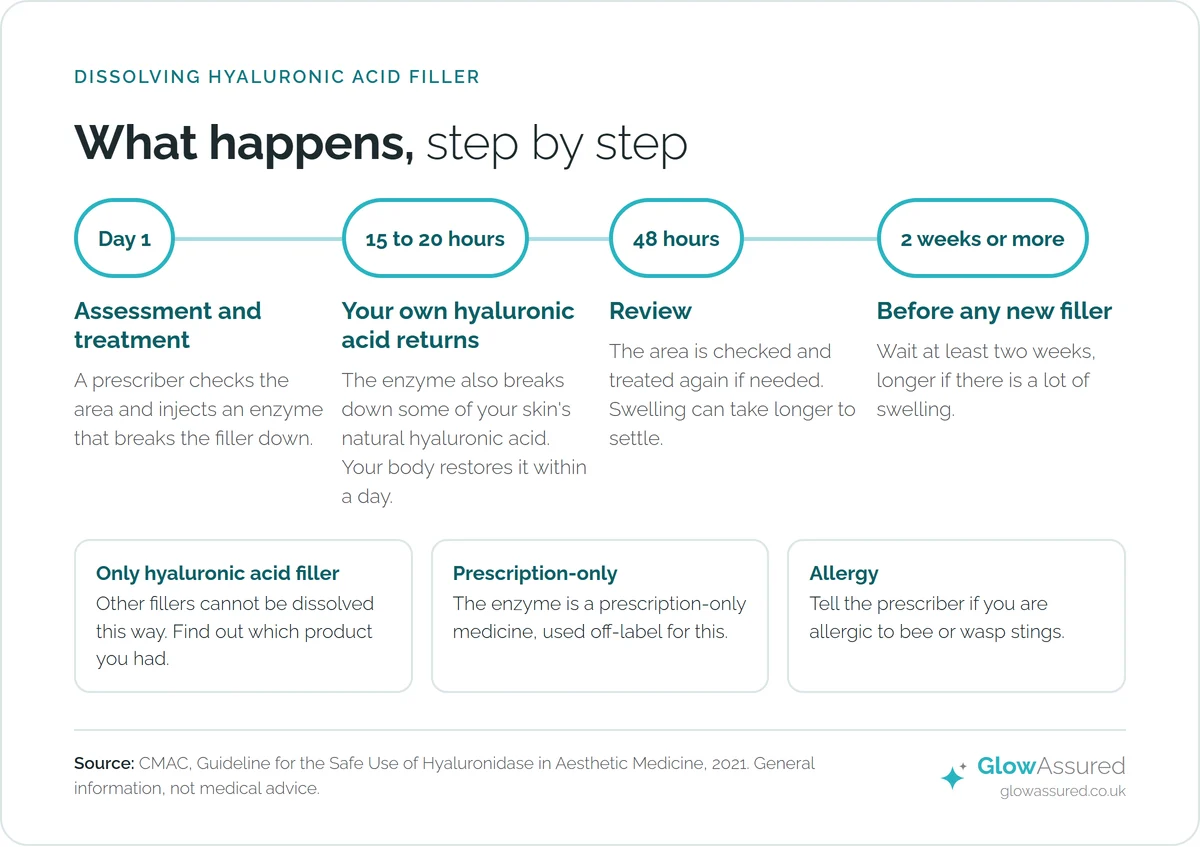
Hyaluronidase is a prescription-only medicine in the UK (emc, product information). The government notes it “is not licensed for use in dissolving dermal fillers but is used ‘off-label’” (DHSC). Off-label means the medicine is being used outside what its licence covers. A prescriber can do that, but CMAC says “the patient must be advised of its off-license status” as part of consent.
The medicine is injected into or around the filler. CMAC’s guideline says that after planned dissolving “the patient can be assessed after 48 hours and the treatment repeated if necessary”, and that swelling can take longer than 48 hours to settle. In the eye clinic series above, 59 per cent had a satisfactory result and 24 per cent needed further hyaluronidase. Eighteen per cent reported facial changes such as hollowing afterwards, which the authors linked to how much filler had been there and for how long. Again, that is an under-eye series.
The product information lists local irritation, infection, bleeding and bruising as rare, and says “severe allergic reactions including anaphylaxis have been reported rarely”. CMAC says redness at the injection site is common. Its hyaluronidase guideline says the allergy figure “is often widely quoted as approximately 0.1 percent”, that since 1949 there have been four published case reports of reactions needing adrenaline, and that allergy to bee and wasp venom raises the risk of a cross-reaction, so tell the prescriber about any such allergy. CMAC expects clinics to keep “a stock of adrenaline in the event of anaphylaxis”.
How long does filler dissolving take?
We found no guidance that gives a typical time for filler to disappear from lips or cheeks, so be wary of anyone who promises one. What the sources do say: the enzyme acts quickly and is short-lived (in animal tissue its activity “diminished within 30 min”, Hong and others, 2025); CMAC says the body “will restore native HA in 15 to 20 hours”; review is at about 48 hours and may be repeated; and swelling can outlast that.
If you want filler again afterwards, CMAC “recommends waiting a minimum of two weeks until the swelling has settled, longer in the event of significant postprocedural swelling”. By then no enzyme activity remains to dissolve the new filler.
Who should dissolve filler
Because hyaluronidase is prescription-only, dissolving involves a prescriber, such as a doctor or a nurse prescriber. The NHS says a practitioner “should have the right training, skills and insurance to safely carry out the procedure”, and to avoid anyone who has “only completed a short training course”. Our guide to choosing a qualified practitioner explains how to search the regulators’ registers and the voluntary registers.
Welsh law does not do this checking for you. The special procedures licensing scheme, in force since 29th November 2024, covers only acupuncture, body piercing, electrolysis and tattooing (Welsh Government). In 2023 the Welsh Government said there was “no firm timetable in place at present for considering the inclusion of any additional procedures” (Senedd written question 89425), and in October 2026 Senedd Research reported that no Welsh reform had been announced.
If you are worried about your filler
For any of the emergency signs above, get emergency help as described there and do not wait for the clinic. For anything else, such as a lump, swelling or a result you are unhappy with, contact the practitioner who treated you first. If you are not happy with how they respond, clinics registered with Healthcare Inspectorate Wales (HIW) “must have a procedure for dealing with patients’ complaints”, and HIW can check a registered service against its standards, though it says “we cannot investigate your complaint”. Injecting “a substance or substances into the skin for cosmetic purposes” does not on its own require a clinic to register with HIW (Care Standards Act 2000, section 2), so many aesthetics clinics in Wales are not registered. Ask the clinic whether it is. The JCCP and Save Face take concerns about practitioners on their registers, and you can report a business to Trading Standards through the Citizens Advice consumer service, though that will not get you a refund.
Our clinic guide lists clinics across Wales, our dermal fillers page explains the treatment, and our guide to what lip filler costs in Wales covers what a price should include. Our clinical lead, Sue Burge, is a registered nurse and nurse prescriber, and she reads every guide on this site before it goes live.
Sources
- Jordan DR, Stoica B, Filler Migration: A Number of Mechanisms to Consider, 2015
- Diwan Z and others, Evaluation of Current Literature on Complications Secondary to Lip Augmentation Following Dermal Filler Injection, 2023
- Trinh LN and others, Delayed Complications following Dermal Filler for Tear Trough Augmentation, 2022
- Murray G and others (CMAC), Guideline for the Safe Use of Hyaluronidase in Aesthetic Medicine, 2021
- Wilde CL and others, The Posthyaluronidase Syndrome, 2024
- Arrigoni F and others, Hyaluronidase Use in Aesthetic Medicine, 2025
- Wang H and others, Foreign Body Granulomas Reaction Related to Collagen Stimulatory Cosmetic Fillers, 2025
- Hong GW and others, How Should We Use Hyaluronidase for Dissolving Hyaluronic Acid Fillers?, 2025
- emc, Hyalase 1500 I.U. summary of product characteristics
- DHSC, The licensing of non-surgical cosmetic procedures in England: consultation document
- NHS, Choosing who will do your cosmetic procedure
- NHS, Vision loss
- Welsh Government, Wales first in UK to implement licensing for special procedures like tattoos
- Senedd, Written question 89425
- Senedd Research, Regulating cosmetic procedures in Wales: keeping pace with a growing market
- Healthcare Inspectorate Wales, Provide feedback about a healthcare service
- JCCP, Raising a concern
- Save Face, Raise a concern
- Citizens Advice (Wales), Reporting to Trading Standards
- CMAC, Consensus Opinion for the Management of Soft Tissue Filler Induced Vision Loss, 2021
- Care Standards Act 2000, section 2