What lip filler costs in Wales
Among clinics in Wales that publish an exact price for 1ml of lip filler, prices ran from £150 to £300, with a middle figure of £220. For 0.5ml, prices ran from £110 to £200, with a middle figure of £175. These are prices published on the websites of clinics in our guide, checked 30th October 2026. The sample is small, so treat the figures as a rough guide, not a going rate.
How we checked lip filler prices
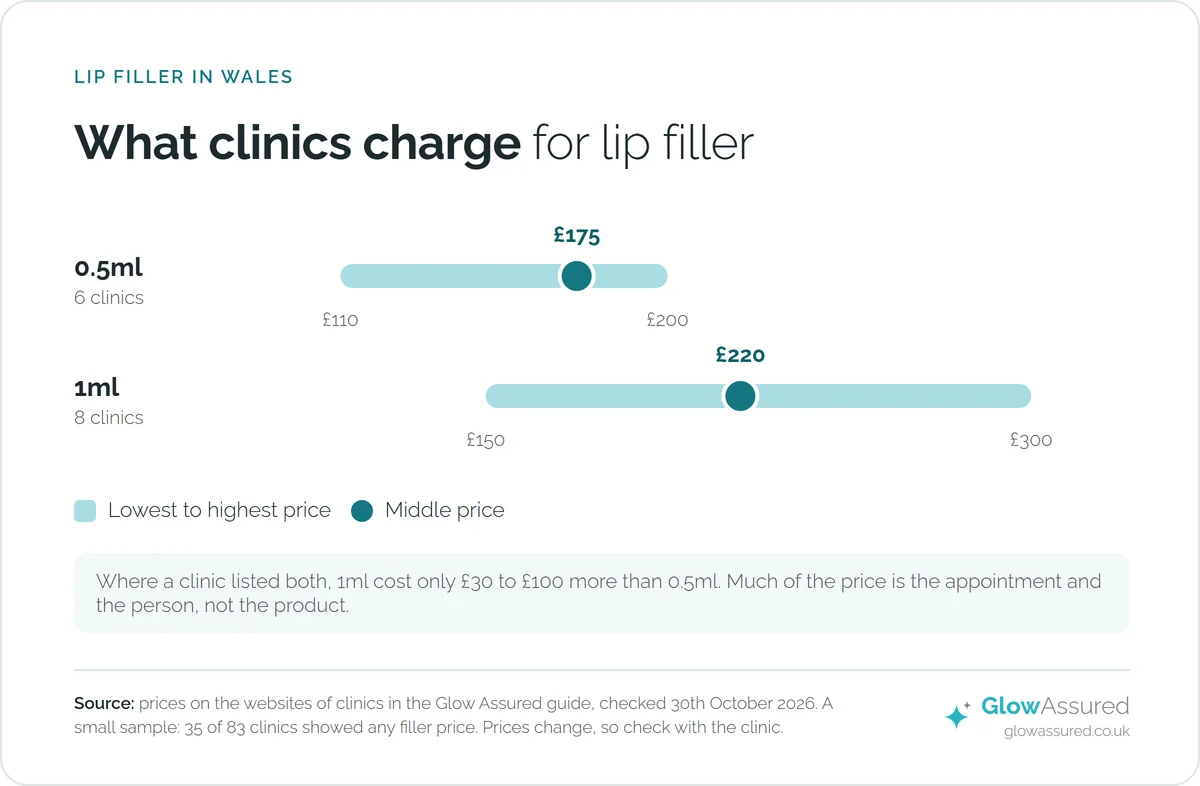
We looked at the websites of the 83 clinics in our clinic guide that list dermal fillers. Only 35 showed any filler price. Many of those gave only a “from” price with no amount of filler attached, which tells you very little. Eight clinics published an exact price for 1ml of lip filler (nine prices, because one lists a standard and a premium product), and six published an exact price for 0.5ml. The ranges and middle figures above come from those few clinics.
We have not named clinics or listed their prices, because prices change and a list like that would soon be wrong. We have not split the figures by town either. The sample is too small to say that Cardiff or Swansea costs more or less than anywhere else. Our Cardiff and Swansea pages list the clinics in each area, and the clinic’s own site or a phone call will give you its current price.
Too few clinics published a clear price with an amount of filler for cheeks, chin or under-eye for us to give a fair range for those areas.
Why 0.5ml and 1ml are priced differently
The millilitre figure is the amount of filler you are paying for. In our sample, 1ml was not twice the price of 0.5ml. Five clinics published both, and at each one 1ml cost between £30 and £100 more than 0.5ml, so the second half-millilitre cost far less than the first. That pattern suggests much of what you pay for is the appointment and the person doing it, not the product.
Clinics do not all sell in the same units. In our sample, some priced 0.7ml, 1.1ml, 1.4ml or 2ml of filler, some offered 2ml over two sessions, some gave two prices for the same amount depending on the brand of filler, and some priced a named technique, such as “Russian lips”, separately from a standard lip treatment. When comparing two prices, check that you are comparing the same amount of the same product.
How much you need is a question for the consultation, not the price list.
What the price should cover
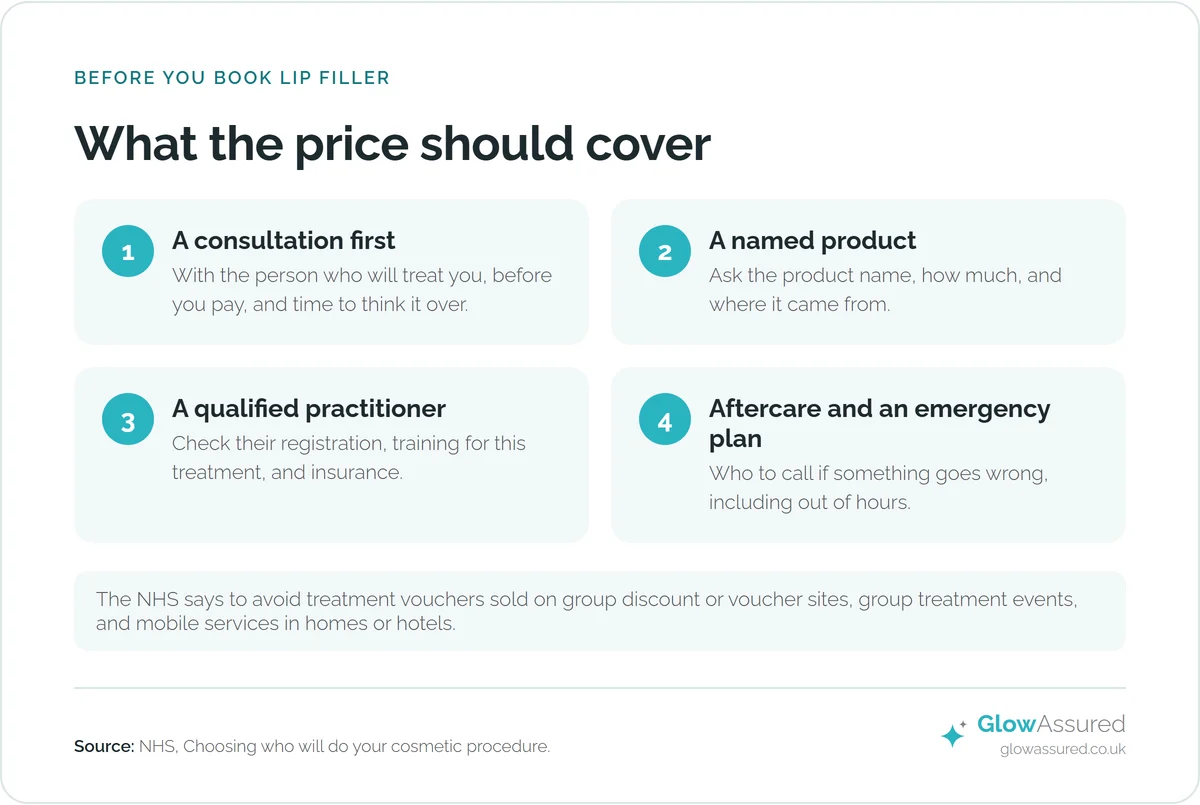
A low price is not wrong in itself. It is worth questioning when you cannot see what it includes. The NHS advice on choosing who will do your cosmetic procedure covers the consultation, the product, the practitioner and aftercare. Each one costs the clinic something to provide.
A consultation with the person who will treat you. The NHS says to “always book a consultation with the person who will do the procedure before making your final decision”, and not to pay for a procedure until you have had one. A price that only works if you book and pay on the spot skips this.
The product. The NHS notes there are “a lot of different versions available” and says to ask the name of the product and where it came from. In our sample, clinics that named brands charged different prices for different brands, so the word “filler” on a price list does not tell you what will be injected.
Who injects. The NHS says dermal fillers “do not always need a prescription”. The medicines regulator explains why: most fillers are not medicines, so it “is not able to regulate them as a prescription only medicine” (MHRA, 2022). In Wales they are not covered by the special procedures licensing scheme, which under the Public Health (Wales) Act 2017 covers only acupuncture, body piercing, electrolysis and tattooing. Senedd Research noted in October 2026 that many dermal filler treatments “may be carried out by individuals who are not regulated healthcare professionals”. Training, registration and insurance all cost the practitioner money, and the NHS says to avoid anyone who has only done a short course. Our guide to choosing a qualified practitioner explains how to check the registers.
Aftercare and a plan if something goes wrong. The NHS says to ask what aftercare you can expect, who will look after you, and what to do if something goes wrong or you are not happy with the result. The UK clinicians’ group CMAC, in its guideline on filler-induced vascular occlusion, says practitioners “must be able to recognize the clinical presentation of ischemia, having clear protocols and referral pathways in place”, and that every patient should be given emergency contact details. Hyaluronic acid filler can be dissolved with hyaluronidase, a prescription-only medicine, so a clinic’s plan for a blocked vessel depends on a prescriber being involved. A government consultation published in October 2026 puts it plainly: “timely access to prescription medications is needed to respond to emergencies or complications”. None of that is free to provide, and a very low price may mean it is not provided.
The NHS also lists “treatment vouchers sold online on group discount or voucher sites” among the things to avoid, along with group treatments, events involving alcohol, and mobile services in places such as private homes or hotels. A deal that only makes sense if you book today is a deal to walk away from.
What to ask about the price
- Does the price include a consultation before the day, with the person who will inject?
- How much filler is it, and what is the product name?
- Is the “from” price for the treatment I am asking about, or for the smallest option?
- Who will inject, and what are their qualifications, training and insurance?
- What aftercare is included, and who do I contact if I am worried, including out of hours?
- If something goes wrong, or I am not happy, what happens and would it cost extra?
- Is there a cooling-off period after the consultation?
The NHS says your practitioner “should give you time after your consultation to decide whether you want to go ahead”. If any answer is vague, or changes when you ask again, that is a better reason to look elsewhere than any price.
The cost of a problem
A problem with filler can cost more than the filler. Dissolving hyaluronic acid filler is a separate treatment by a prescriber, and the UK guideline on hyaluronidase says the patient is reviewed after about 48 hours and “the treatment repeated if necessary” (Murray and others, 2021). Our guides on whether filler can move or be dissolved and on filler and blindness cover what can go wrong, the warning signs and what to do.
Our dermal fillers page explains the treatment. Our clinical lead, Sue Burge, is a registered nurse and nurse prescriber, and she reads every guide on this site before it goes live.
Sources
- Prices published on the websites of clinics in our guide, checked 30th October 2026 (83 sites checked, 35 showing a filler price, 8 with an exact 1ml lip price, 6 with an exact 0.5ml lip price)
- NHS, Choosing who will do your cosmetic procedure
- NHS, Before you have a cosmetic procedure
- Public Health (Wales) Act 2017, section 57
- Senedd Research, Regulating cosmetic procedures in Wales: keeping pace with a growing market
- CMAC, Guideline for the Management of Hyaluronic Acid Filler-induced Vascular Occlusion
- Murray G and others (CMAC), Guideline for the Safe Use of Hyaluronidase in Aesthetic Medicine
- DHSC, Restrictions on the performance of high-risk cosmetic and wellbeing procedures in England: consultation document
- MHRA, Consultation outcome: scope of the medical devices regulations