Can filler cause blindness? The real risk and the warning signs
Yes. Filler injected into a blood vessel by accident can block the blood supply to the eye, and blindness is a recognised complication that published reviews describe as rare but, in most reported cases, permanent. If your eyesight changes during or after filler, call 999 or go to A&E straight away, and do not drive yourself.
Vascular occlusion symptoms: what to watch for
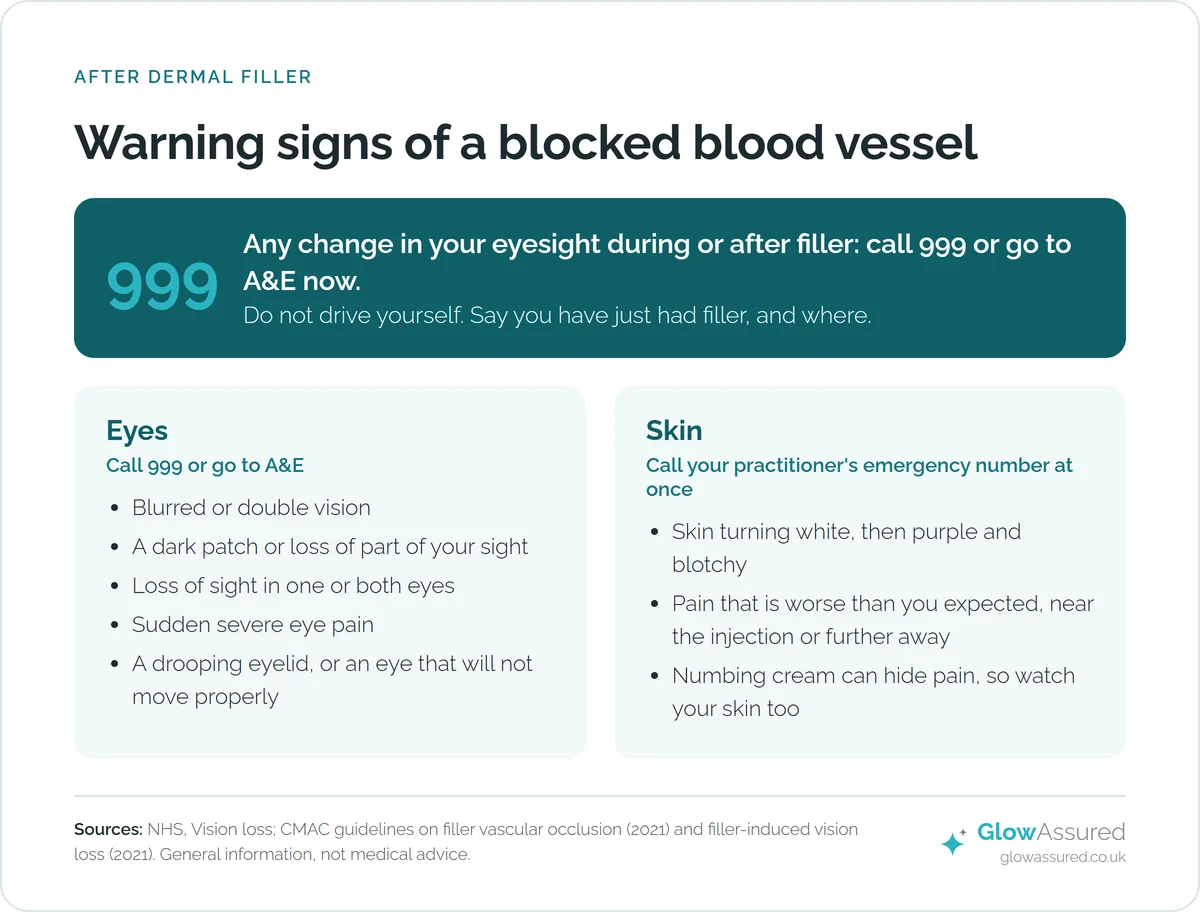
A vascular occlusion is a blocked blood vessel. The UK clinicians’ group CMAC, in its guideline on filler-induced vascular occlusion, says every patient “should be educated on the warning signs of a vascular occlusion and be provided with emergency contact details”. These are the signs it and the case reviews describe.
Eyes
- Any loss of sight in one or both eyes, partial or complete.
- Sudden severe eye pain.
- A drooping eyelid, or an eye that will not move properly. In the largest review of published cases these were reported in 56 per cent and 44 per cent (Doyon and others, 2024).
- Stroke-like features, seen in 19 per cent of those cases. The NHS says stroke symptoms include “drooping on one side of the face, weakness in the arm and slurred speech”, and to call 999 if you think someone is having a stroke.
Skin
- Pain that is more than you expected, during or after treatment. CMAC says “sudden escalating pain during treatment either at the site of the injection or in a distant site is not normal”.
- Do not wait for pain. It “is not always present during the early stages”, and local anaesthetic can mask it until it wears off.
- Skin going white (blanching), which “may be fleeting but will be replaced by a reticulated purple pattern”, a purple mottling of the skin.
- CMAC notes these colour changes can be harder to spot in skin of colour, so do not rely on colour alone.
What to do
If your eyesight changes in any way during or after filler, call 999 or go to A&E straight away. That includes blurring, double vision, a dark patch, loss of part of your vision and sudden severe eye pain, even if you can still see. Do not drive yourself. Tell the emergency team that you have just had filler, where it was injected and, if you know it, the product name.
The NHS says to go to A&E or call 999 if you “suddenly cannot see from 1 or both eyes” or “suddenly have severe eye pain”, and “do not drive to A&E. Ask someone to drive you or call 999 and ask for an ambulance” (NHS, Vision loss). That page is general advice and was not written for filler. The UK clinicians’ guidance on filler and vision loss goes further. It says the visual disturbance “may occur as a single symptom or a combination of symptoms”, counts blurry vision as partial vision loss, and tells practitioners to “arrange immediate transfer to eye hospital or emergency department” (CMAC, 2021). That is why we say any change in vision after filler is a 999 emergency.
Ask someone with you to call your practitioner’s emergency number while you get emergency help, or call it yourself once 999 has been called. Do not wait for the practitioner, or for NHS 111, before calling 999. CMAC says that “in the event of a suspected vascular occlusion, an urgent face-to-face assessment must be scheduled”.
Time matters. CMAC cites research suggesting “a vascular occlusion can cause a retinal infarction in 12 to 15 minutes”, and the 2024 review found that people who still had some sight when the problem started were more likely to improve.
How filler can cause blindness
Hyaluronic acid fillers “can be implanted through all tissue planes, bringing an associated risk of inadvertent intravascular injection” (CMAC). If filler enters an artery it blocks the blood supply, and “if a vascular occlusion is not promptly diagnosed and managed appropriately, tissue necrosis can ensue”. The arteries of the face connect with those that supply the eye and the brain, which is why CMAC says “blindness and stroke are both possible”. And “vascular complications can occur when using either a needle or a cannula”.
How rare is blindness from filler?
Nobody knows the rate. The figures that circulate come from three reviews by one research group that counted cases found in published medical literature: 98 cases of vision changes up to 2015 (Beleznay and others, 2015), 48 more up to September 2018 (Beleznay and others, 2019), and 365 more up to March 2023 (Doyon and others, 2024). That is about 500 published cases worldwide over roughly a century. These are counts of reports, not a rate. The reviews do not say how many filler treatments were given in the same period, so they cannot tell you the risk per treatment, and any “1 in X” figure you see elsewhere did not come from them. The authors call it “a rare but disastrous complication”.
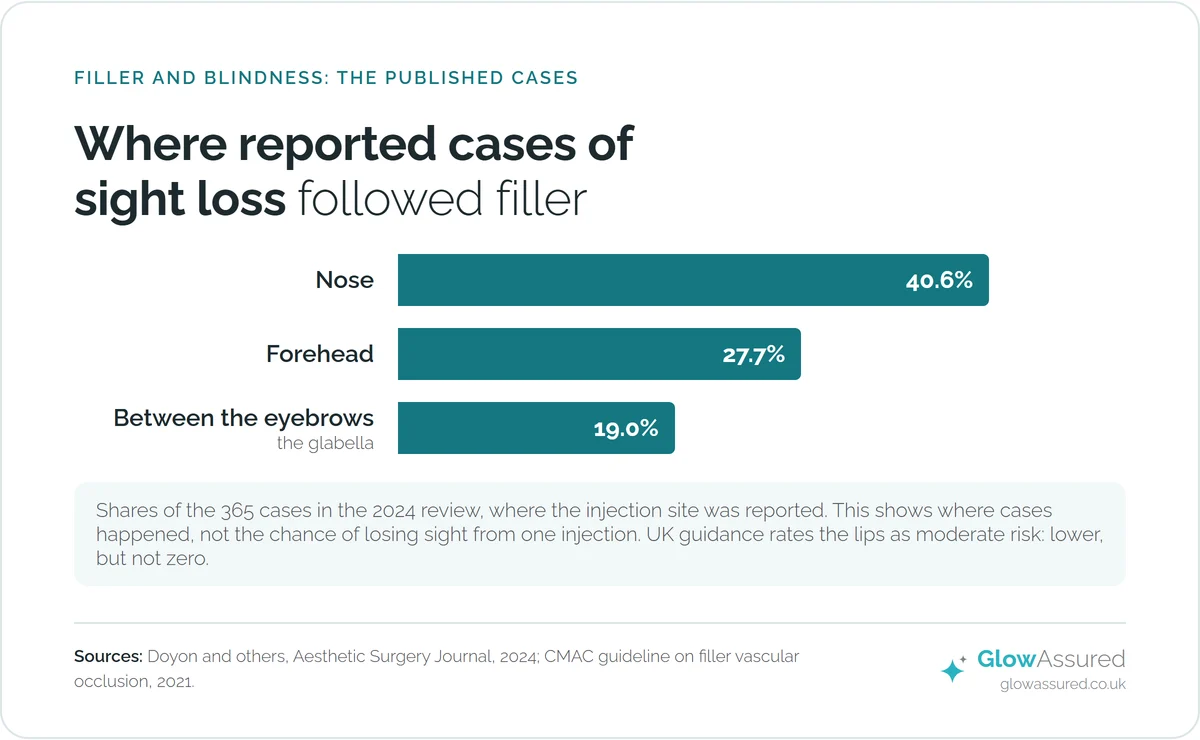
Reported cases are not spread evenly across the face. In the 2024 review, 40.6 per cent of cases followed injection in the nose, 27.7 per cent in the forehead and 19.0 per cent in the glabella, the area between the eyebrows. The authors call these the highest-risk sites, but the figures are shares of reported cases, not the chance of losing sight from an injection in each area. CMAC’s risk table rates the glabella, nose and forehead as very high risk; the temples, the lines from the nose to the corners of the mouth (nasolabial folds), the hollows under the eyes (tear troughs), the area around the eyes and the part of the cheek nearest the nose as high; and the lips and the area around the mouth as moderate. Moderate is not zero. The published summaries of these reviews do not give a separate figure for lip filler.
Can it be treated?
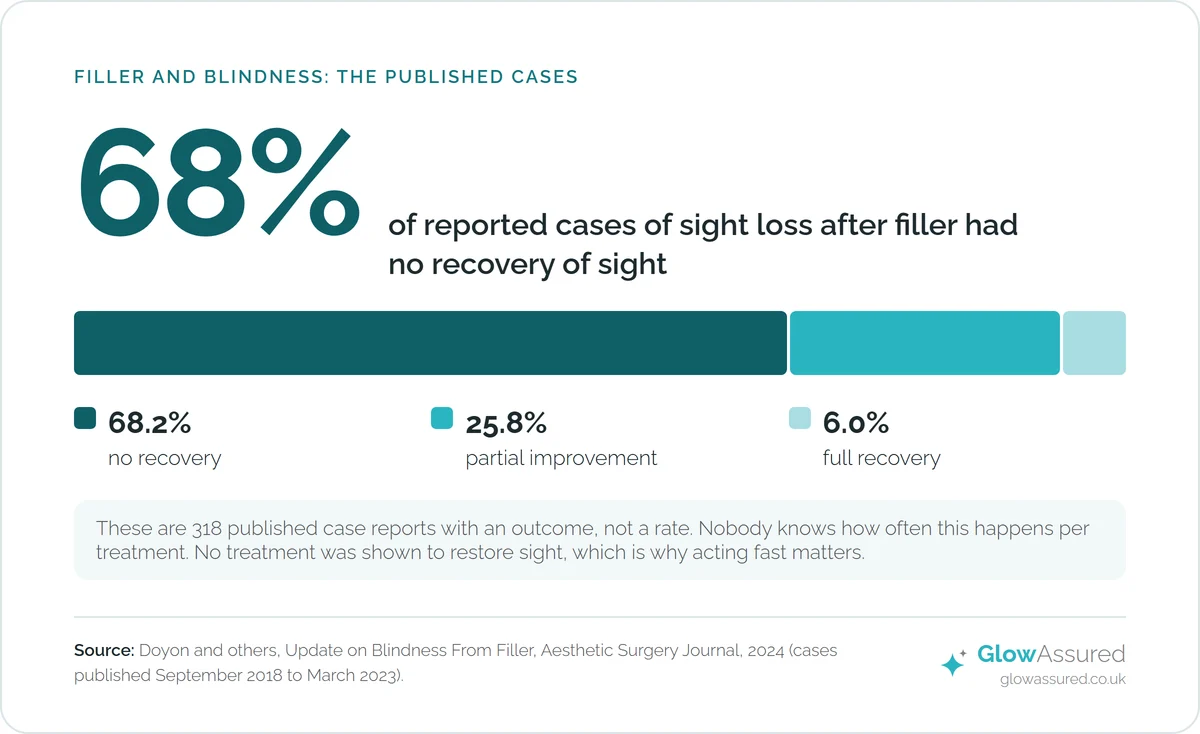
Outcomes in the published cases are poor. In the 2024 review, 6 per cent recovered their sight fully, 25.8 per cent improved partly, and 68.2 per cent had no recovery. The authors state: “No treatments were significantly associated with visual improvement.” The most-used treatment, in 70 per cent of cases, was hyaluronidase, the prescription-only medicine that dissolves hyaluronic acid filler, injected at or near the filler site. It has not been shown to restore sight.
That is why the warning signs come first in this guide. The evidence supports prevention and immediate emergency care, not reassurance that sight can be restored afterwards.
A blocked vessel in the skin, short of the eye, is where prompt treatment counts. CMAC expects practitioners to have “clear protocols and referral pathways in place”, and a government consultation published in October 2026 says “timely access to prescription medications is needed to respond to emergencies or complications”, naming adrenaline and hyaluronidase. That needs a prescriber.
Reducing the risk before you book
You cannot bring the risk to zero, but you can choose a practitioner who can recognise a blocked vessel and has a plan for it. The NHS advice on choosing who will do your cosmetic procedure says to “always book a consultation with the person who will do the procedure before making your final decision”, and to ask about their training, the common complications, the product name and where it came from, and what to do if something goes wrong. Avoid anyone who has “only completed a short training course”, mobile services in homes or hotels, and practitioners who only advertise on social media. Our guide to choosing a qualified practitioner explains how to check the registers.
Three further questions are ours, drawn from the CMAC guideline rather than the NHS list:
- Can you recognise and treat a blocked blood vessel, and do you have the emergency medicines to hand?
- What is your emergency contact number, and what happens out of hours?
- Where would you send me if the eye is involved?
In Wales, fillers are not covered by the special procedures licensing scheme, which under the Public Health (Wales) Act 2017 applies only to acupuncture, body piercing, electrolysis and tattooing. Senedd Research reported in October 2026 that many filler treatments “may be carried out by individuals who are not regulated healthcare professionals”, so the checks are yours to make.
If something has gone wrong
Get the emergency care above first. Afterwards, clinics registered with Healthcare Inspectorate Wales (HIW) “must have a procedure for dealing with patients’ complaints”, and HIW can check a registered service against its standards. Injecting “a substance or substances into the skin for cosmetic purposes” does not on its own require a clinic to register with HIW (Care Standards Act 2000, section 2), so many aesthetics clinics in Wales are not registered. Ask the clinic whether it is. The JCCP and Save Face take concerns about practitioners on their registers.
Our guide on whether filler can move or be dissolved covers non-urgent problems, what lip filler costs in Wales covers what a price should include, and our clinic guide lists clinics across Wales. Our clinical lead, Sue Burge, is a registered nurse and nurse prescriber, and she reads every guide on this site before it goes live.
Sources
- CMAC, Guideline for the Management of Hyaluronic Acid Filler-induced Vascular Occlusion, 2021
- Beleznay K and others, Avoiding and Treating Blindness From Fillers: A Review of the World Literature, 2015
- Beleznay K and others, Update on Avoiding and Treating Blindness From Fillers, 2019
- Doyon VC and others, Update on Blindness From Filler: Review of Prognostic Factors, Management Approaches, and a Century of Published Cases, 2024
- NHS, Vision loss
- NHS, Symptoms of a stroke
- NHS, Choosing who will do your cosmetic procedure
- DHSC, Restrictions on the performance of high-risk cosmetic and wellbeing procedures in England: consultation document
- Public Health (Wales) Act 2017, section 57
- Senedd Research, Regulating cosmetic procedures in Wales: keeping pace with a growing market
- Healthcare Inspectorate Wales, Provide feedback about a healthcare service
- JCCP, Raising a concern
- Save Face, Raise a concern
- CMAC, Consensus Opinion for the Management of Soft Tissue Filler Induced Vision Loss, 2021
- Care Standards Act 2000, section 2